‘Enough is enough’: Man City and PSG play wonderful football – but state-owned clubs are finally coming under proper scrutiny
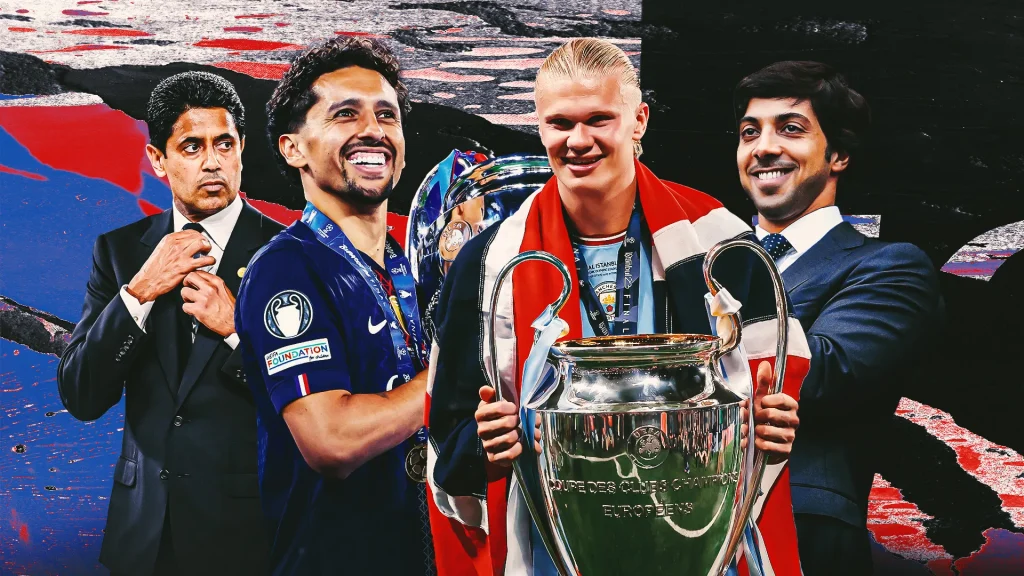
UEFA’s FFP regulations were obviously introduced to try to control spending in football but, up until now, both City and PSG have avoided heavy sanctions.
“The two of them agreed settlements with UEFA in 2014 which resulted in fines and squad limits in the Champions League,” Panja says. “But when UEFA banned City from the Champions League for two years in 2020, the suspension was overturned by the Court of Arbitration for Sport (CAS) because many of the offences were time-barred.
“PSG were also investigated again after the football earthquake they caused in 2017 by obliterating the player transfer record by paying Neymar’s €222m buyout clause, which more than doubled the previous world record fee, while also agreeing a massive deal with Monaco for Kylian Mbappe.
“An investigatory panel was set up and they went through all of PSG’s finances meticulously over a long period of time, but the members of the panel were split over what to do. The members of the panel that wanted to do the job properly were like, ‘This needs to be referred to the adjudicatory chamber as we think that there’s been a breach.’
“But the chairman, in this case the former Belgian Prime Minister Yves Leterme, thought differently. He felt that nothing untoward had gone on, so much so, in fact, that when it went to the adjudicatory chamber, which was run at the time by a senior judge from Portugal called Jose Narciso da Cunha Rodrigues, he looked at it and basically said, in quite scathing terms, ‘Looking at your report, and what you’ve concluded based on the evidence, you need to take this back. This isn’t up to scratch. You’ve made a manifest error here in relation to a 100 million-plus valuation of a sponsorship deal that the investigators took at face value.’
“At the same time, though, PSG take this process to CAS, and this is where it gets really interesting, because when you take a FFP case to CAS, the judge is out of the loop and the adjudicatory chamber is out of the loop. The entire case is handled by the UEFA administration. So, it is up to UEFA to decide how hard and how much it wants to defend its investigators and its judge. And, in this instance, UEFA sided with PSG’s argument.
“PSG said that the judge took too long in referring the case back to the investigators. They said it had to be done within 10 days. The judge says, ‘You’re misinterpreting the rules, and it’s impossible that anyone could analyse an entire case in 10 days. It’s not going to happen. The whole point is that you start the review process within 10 days.’
“However, to everyone’s shock, the UEFA administration, the one run by Aleksander Ceferin, the man who apparently is the great hero in tackling good governance when it comes to FIFA president Gianni Infantino, ultimately accepted argument that the judge took too long in referring the case back to UEFA’s investigators and basically said, ‘Yeah, fine, you’re right, let’s just move on.’
“So, while PSG have, in recent years, built a team that’s now hugely admired, a lot of people would tell you that the only difference between PSG and City today is that PSG have effectively got away with breaching financial rules, whereas ultimately City have not.”
City continue to maintain that they possess “irrefutable evidence” of their innocence, but Panja feels that for all of the political power the UAE holds, the club’s owners might ultimately be forced to admit defeat in their bid to retain control of the club: “To be honest, the damage is already done. The verdict will stand there as a testament to cheating. Legal documents are normally quite dry, but the language used is so strong that it’s going to be hard to forget something so emphatic.
“They’ve had a very belligerent approach for all of these years, so it’s very hard to think that they’ll now say, ‘Okay, yeah, it’s a fair cop, we’ll stand down now.’ Having said that, though, their position would become untenable if these negative headlines persist, making walking away the sensible course of action, because, for all the beautiful football played by one of the best teams England has ever seen, for all the titles won, all of City’s achievements are now tarnished by the biggest cheating scandal in the history of English football. And it’s very hard to separate the scandal from the football, however much people connected with the club are trying to do so.
“It’s thus very difficult to see these guys being able to continue as the owners of a Premier League club. Something has to give, and it feels like a case of when, and not if, they move on because, for every day that this team is owned by the current owners, the stain on the club’s reputation will remain.”
PSG are hardly squeaky clean by comparison, but it does feel as if they’ve managed to make people forget that they were fined for breaching FFP regulations again just four years ago, with the majority of football fans blinded by the brilliance of Khvicha Kvaratskhelia & Co.
“This is exactly how sports washing works,” McGeehan says. “We all remember when PSG were a bit of a joke, because it’s not that long ago. They were this kind of splash-the-cash club, seen as the product of a brash, vulgar project. And the country was viewed in similarly negative terms. So, it wasn’t working all that well as a sports washing project at all.
“And compare that to how City were doing at the time. They had an ultra-professional reputation, while Khaldoon Al Mubarak was held up as this wonderful steward of the club, and Pep Guardiola was only further helping enhance their image on and off the field. But I think the Qataris just got lucky in a certain sense with Luis Enrique, who kind of threw out the old system and got them playing wonderful football that’s resulted in the conversation around the club focusing almost exclusively on what’s happening on the field.”
In that sense, the timing of Wednesday’s game hardly suits PSG as the pre-match narrative has focused almost exclusively on City’s financial fraud and, as Johnson points out, the visitors will not appreciate the comparisons between the two state-owned clubs.
“I’d imagine that they would be very irritated by the nature of the debate, because I think if we’re being totally honest and pragmatic about it, one club went one way after those brushes with FFP and the other club went the other,” he says. “And I think at this moment in time, many people would say that PSG probably went about tackling their difficulties the right way.
“Obviously, it’s a very contentious situation. There are a lot of murky topics when discussing that. It really requires getting into the weeds to determine what exactly PSG did differently to Manchester City but, ultimately, depending on what happens in terms of City’s situation with the Premier League, there probably will be a light shone back on what has happened over the last couple of years with clubs that have reached settlements with UEFA. Because we’re not just talking about PSG and City there. Other clubs have had issues, but these are the two most prominent names.
“But I do think PSG would resent being tarred with the same brush as City. Because, ultimately, they have gone about building their business model in a completely different way. Some things that PSG have done, especially the way in which they’ve become a lifestyle brand away from the pitch, nobody can argue with the fact that it’s been an overwhelming success over the best part of 10 years. That’s something that City have seemingly not managed to do as well as PSG. So, I definitely think that in terms of comparing the two, PSG would be very put out by people who suggest that they’re basically the same as City.”